Academy 1/72 Corsair F4U-1A, Tommy’s Big Hog, Ondongo, 1943.
-
speedgraflex

- Moderator
- Posts: 11535
- Joined: Fri Feb 10, 2017 11:08 pm
- Contact:
Re: Academy 1/72 Corsair F4U-1A, Tommy’s Big Hog, Ondongo, 1
You bring up an excellent point because I am naturally afraid of heights and taking away flooring for me as a non pilot afraid of heights terrifies me. I also spend a lot of time worrying about the placement of the seat so that the two paddle like supports are located in the right place for the same reason; I am worried the pilot will fall. I keep telling myself that these designs were vetted by great engineers and test pilots, but I was surprised that the mandate from the Navy was interpreted by Chance Vought as the “smallest fuselage for the largest engine.” To me, especially after setting up on the slender Fw190 and Me109, this is a big machine!
Make more models!
-
Stikpusher

- Moderator
- Posts: 21386
- Joined: Sat Apr 05, 2014 8:37 pm
- Location: Ceti Alpha 5
Re: Academy 1/72 Corsair F4U-1A, Tommy’s Big Hog, Ondongo, 1
The F4F and F2A also had those “floorless” cockpits with windows in the fuselage bottom. As did several bomber types such as the SBD. Remember that the pilot will still be belted into his seat, and his feet should be on those rudder pedals pretty much the entire flight. And that seat is mounted on some sort of stout frame. He’s not going anywhere. Having your feet hanging out into “nothingness” in flight can be kind of exhilarating.
And that is an awesome photo of the sunken Corsair.
And that is an awesome photo of the sunken Corsair.
"Surely I have made my meaning plain? I intend to avenge myself upon you, Admiral. I have deprived your ship of power, and when I swing 'round, I intend to deprive you of your life."
FLSM
FLSM
-
BlackSheep214
- Elite Member
- Posts: 13598
- Joined: Sun Apr 06, 2014 8:47 pm
Re: Academy 1/72 Corsair F4U-1A, Tommy’s Big Hog, Ondongo, 1
Curious... what would be the purpose of having a floorless cockpit. This is a new one for me.
“Who controls the skies, controls the fate of this Earth”
Author unknown- 352nd Fighter Group, Blue-Nosed Bastards of Bodney
“Send one plane it’s a sortie; send two planes it’s a flight; send four planes it’s a test of airpower. - Richard Kohn
Author unknown- 352nd Fighter Group, Blue-Nosed Bastards of Bodney
“Send one plane it’s a sortie; send two planes it’s a flight; send four planes it’s a test of airpower. - Richard Kohn
-
Stikpusher
- Moderator
- Posts: 21386
- Joined: Sat Apr 05, 2014 8:37 pm
- Location: Ceti Alpha 5
Re: Academy 1/72 Corsair F4U-1A, Tommy’s Big Hog, Ondongo, 1
Aside from the visibility factor with the bottom windows, I would also say it also saves some weight. Two foot troughs are less material than a floorboard capable of supporting a mans weight.
Of course there is the trade off of vulnerability to hostile fire from below.
Of course there is the trade off of vulnerability to hostile fire from below.
"Surely I have made my meaning plain? I intend to avenge myself upon you, Admiral. I have deprived your ship of power, and when I swing 'round, I intend to deprive you of your life."
FLSM
FLSM
-
speedgraflex
- Moderator
- Posts: 11535
- Joined: Fri Feb 10, 2017 11:08 pm
- Contact:
Re: Academy 1/72 Corsair F4U-1A, Tommy’s Big Hog, Ondongo, 1
Designing the Bent-Wing Bird
By Alfred I. Sibila
Naval History Magazine
Volume 9 Number 1
February 1995
Few airplanes in the history of aviation have a design feature as distinctive as the legendary F4U Corsair's inverted gull wing. It has intrigued World War II aircraft buffs for more than half acentury. Form follows function, and the unusual design resulted from a skillful blending of mission requirements with engineering-design expertise by the original designers at Chance Vought Aircraft in East Hartford, Connecticut, in 1938.
The name came from the Vought O2U- and O3U-series observation airplanes that first bore the name Corsair Navy and Marine Corps pilots logged many hours in these sturdy aircraft, mainstays of the airborne Navy in the late 1920s and early 1930s. Later, the name Corsair lived on in the Vought A-7 Corsair II, which performed so admirably in Vietnam and Operation Desert Storm. Chance Milton Vought's O2U first flew in 1926; the Navy's last Corsair II squadron was decommissioned in 1991, but Greek and Portuguese pilots are still flying the aircraft. Back in 1938, however, the men who designed the F4U never dreamed that they were creating a legend.
In the late 1930s, as Europe headed for war, Chance Vought Aircraft, a division of United Aircraft Corporation, was working with the Navy's Bureau of Aeronautics on the preliminary design for a high-performance, carrier-based fighter to be built around the new Pratt & Whitney R-2800 Double Wasp engine. The Double Wasp developed 1,850 horsepower for takeoff and had the potential for reaching 2,000 horsepower—quite an increase from Pratt & Whitney's 1,000-horsepowet Twin Wasp. The Navy asked for proposals early in 1938, and that spring Vought submitted its proposalcompany designation V-166.
The design team had to resolve many conflicting requirements before arriving at the final configuration for an aircraft that promised speeds of 400 miles per hour, and one of the key constraints was the large-diameter propeller required to convert the high engine power to the thrust necessary to achieve maximum performance. The aerodynamicists calculated the static thrust necessary to accelerate the aircraft to takeoff speed and tried to minimize propeller tip-speed compressibility losses in order to achieve maximum performance; selection was based on efficiency throughout all flight regimes-takeoff, climb, cruise, and top speed. Using a new Hamilton Standard propeller design handbook, they determined that the aircraft required a 13-foot, 3-inch three-bladed propeller. By 1938 standards, it was a very big prop.
Excellent slow-speed characteristics in the landing configuration and good stall indications were required for carrier compatibility, but Chief Engineer Rex B. Beisel made it clear to his 90- man engineering staff on many occasions that "speed is king.”
The Corsair's distinctive gull-wing design actually emerged from a small engineering meeting in Rex's office, which had assembled to resolve the conflicting design requirements. The writer recalls that among those present were: Beisel; James M. Shoemaker, Assistant Chief Engineer; Paul S. Baker, Chief of Aerodynamics and Flight Test; William C. Schoolfield, Head of Aerodynamics; Earnest Mailloux, Chief of Structures; George F. Darracott, Head of Weights; Fred N. Dickerman, Design; and yours truly, Aerodynamics. The group reviewed a number of aircraft configurations that had been generated in preliminary design studies.
Assessing the options while sketching on a desk pad, Rex conjectured that if the wing in front view had to be normal to the fuselage at its intersection for low drag, and the landing gear had to be short, why not just leave the wing low, put a little bend in it at the landing gear station, and let it rise to meet the fuselage at right angles?
Then, going outboard, the curved section could rise, meeting the outer panel at the wing-fold station. He also pointed out that such an arrangement would permit an even shorter landing gear than a low-wing. The aerodynamicists confirmed that this configuration would provide essentially the same low drag as a mid-wing. It became clear that the inverted gull wing was the best approach, and Beisel directed that it be incorporated as the basic element of the XF4U-1. The bent-wing bird had been born—and the rest is history.
Mr. Sibila was Vought's Chief of Aerodynamics and Manager of Space Sciences when he retired in 1979 after more than 42 years with the company. He joined Chance Vought Aircraft in 1937 as an Aerodynamics and Flight Test Engineer and worked on aircraft, missiles, and space programs throughout a distinguished career. We regret to report, he died in May 1994.
By Alfred I. Sibila
Naval History Magazine
Volume 9 Number 1
February 1995
Few airplanes in the history of aviation have a design feature as distinctive as the legendary F4U Corsair's inverted gull wing. It has intrigued World War II aircraft buffs for more than half acentury. Form follows function, and the unusual design resulted from a skillful blending of mission requirements with engineering-design expertise by the original designers at Chance Vought Aircraft in East Hartford, Connecticut, in 1938.
The name came from the Vought O2U- and O3U-series observation airplanes that first bore the name Corsair Navy and Marine Corps pilots logged many hours in these sturdy aircraft, mainstays of the airborne Navy in the late 1920s and early 1930s. Later, the name Corsair lived on in the Vought A-7 Corsair II, which performed so admirably in Vietnam and Operation Desert Storm. Chance Milton Vought's O2U first flew in 1926; the Navy's last Corsair II squadron was decommissioned in 1991, but Greek and Portuguese pilots are still flying the aircraft. Back in 1938, however, the men who designed the F4U never dreamed that they were creating a legend.
In the late 1930s, as Europe headed for war, Chance Vought Aircraft, a division of United Aircraft Corporation, was working with the Navy's Bureau of Aeronautics on the preliminary design for a high-performance, carrier-based fighter to be built around the new Pratt & Whitney R-2800 Double Wasp engine. The Double Wasp developed 1,850 horsepower for takeoff and had the potential for reaching 2,000 horsepower—quite an increase from Pratt & Whitney's 1,000-horsepowet Twin Wasp. The Navy asked for proposals early in 1938, and that spring Vought submitted its proposalcompany designation V-166.
The design team had to resolve many conflicting requirements before arriving at the final configuration for an aircraft that promised speeds of 400 miles per hour, and one of the key constraints was the large-diameter propeller required to convert the high engine power to the thrust necessary to achieve maximum performance. The aerodynamicists calculated the static thrust necessary to accelerate the aircraft to takeoff speed and tried to minimize propeller tip-speed compressibility losses in order to achieve maximum performance; selection was based on efficiency throughout all flight regimes-takeoff, climb, cruise, and top speed. Using a new Hamilton Standard propeller design handbook, they determined that the aircraft required a 13-foot, 3-inch three-bladed propeller. By 1938 standards, it was a very big prop.
Excellent slow-speed characteristics in the landing configuration and good stall indications were required for carrier compatibility, but Chief Engineer Rex B. Beisel made it clear to his 90- man engineering staff on many occasions that "speed is king.”
The Corsair's distinctive gull-wing design actually emerged from a small engineering meeting in Rex's office, which had assembled to resolve the conflicting design requirements. The writer recalls that among those present were: Beisel; James M. Shoemaker, Assistant Chief Engineer; Paul S. Baker, Chief of Aerodynamics and Flight Test; William C. Schoolfield, Head of Aerodynamics; Earnest Mailloux, Chief of Structures; George F. Darracott, Head of Weights; Fred N. Dickerman, Design; and yours truly, Aerodynamics. The group reviewed a number of aircraft configurations that had been generated in preliminary design studies.
Assessing the options while sketching on a desk pad, Rex conjectured that if the wing in front view had to be normal to the fuselage at its intersection for low drag, and the landing gear had to be short, why not just leave the wing low, put a little bend in it at the landing gear station, and let it rise to meet the fuselage at right angles?
Then, going outboard, the curved section could rise, meeting the outer panel at the wing-fold station. He also pointed out that such an arrangement would permit an even shorter landing gear than a low-wing. The aerodynamicists confirmed that this configuration would provide essentially the same low drag as a mid-wing. It became clear that the inverted gull wing was the best approach, and Beisel directed that it be incorporated as the basic element of the XF4U-1. The bent-wing bird had been born—and the rest is history.
Mr. Sibila was Vought's Chief of Aerodynamics and Manager of Space Sciences when he retired in 1979 after more than 42 years with the company. He joined Chance Vought Aircraft in 1937 as an Aerodynamics and Flight Test Engineer and worked on aircraft, missiles, and space programs throughout a distinguished career. We regret to report, he died in May 1994.
Make more models!

Re: Academy 1/72 Corsair F4U-1A, Tommy’s Big Hog, Ondongo, 1
Those underwater shots are awesome Bruce!
 I'm also rather partial to a tankard or Mead, or a nice bottle of Nordic Berry Cider if it's hot. If I do drink beer - then yeah I love me some of the good stuff from Germany or Belgium.
Skol!
lol! I used to be a real ale guy, but I've not been much of a beer drinker for the past 15 or so years - I'd much rather a glass of wine or three these daysStikpusher wrote:Franziskaner Weissbier?! That’s good stuff! Stuart, I figured you for an English brown ale type.Prost!
Or Cheers
.
I'm also rather partial to a tankard or Mead, or a nice bottle of Nordic Berry Cider if it's hot. If I do drink beer - then yeah I love me some of the good stuff from Germany or Belgium. Skol!
Stuart Templeton 'I may not be good but I'm slow...'
-
Stikpusher
- Moderator
- Posts: 21386
- Joined: Sat Apr 05, 2014 8:37 pm
- Location: Ceti Alpha 5
Re: Academy 1/72 Corsair F4U-1A, Tommy’s Big Hog, Ondongo, 1
The F4U has quite the history.
"Surely I have made my meaning plain? I intend to avenge myself upon you, Admiral. I have deprived your ship of power, and when I swing 'round, I intend to deprive you of your life."
FLSM
FLSM
-
speedgraflex
- Moderator
- Posts: 11535
- Joined: Fri Feb 10, 2017 11:08 pm
- Contact:
Re: Academy 1/72 Corsair F4U-1A, Tommy’s Big Hog, Ondongo, 1
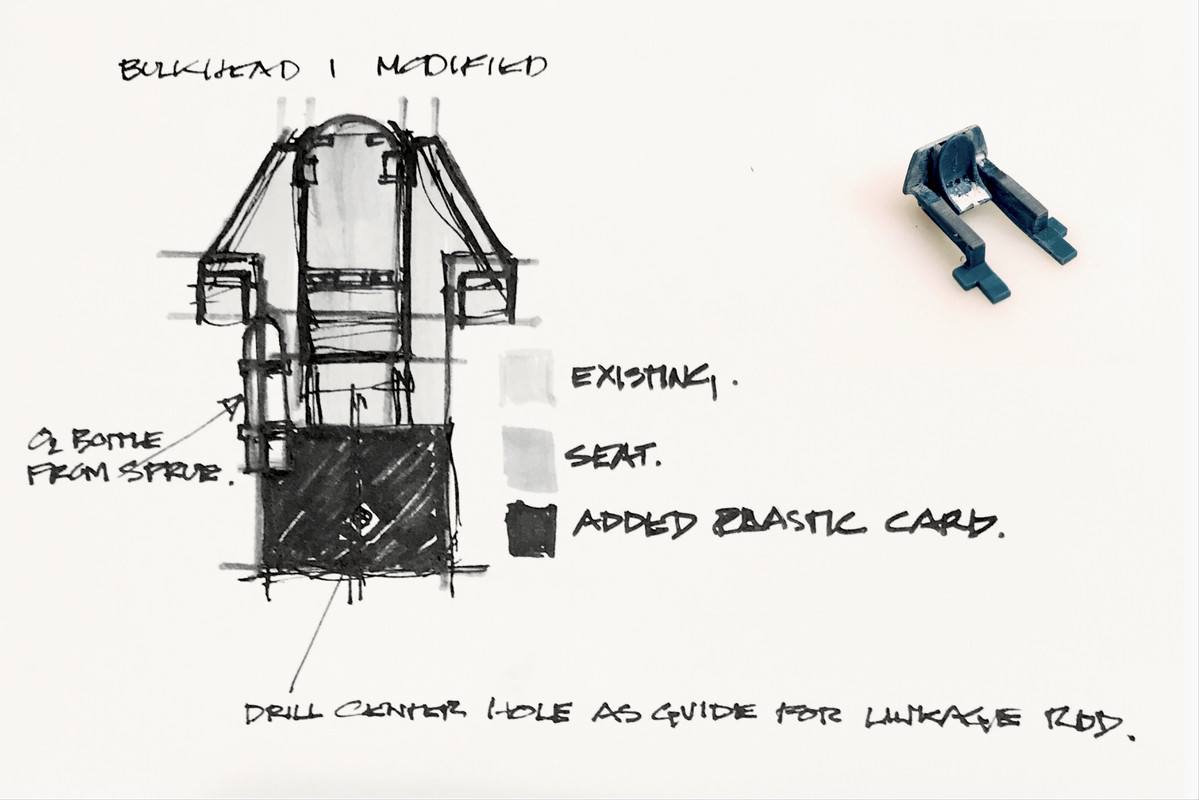
My current Corsair planning. Actually this is a squared off version of the actual bulkhead which will hold the rod linking it to the forward section. I almost sound like I know what I am doing and where this is all headed.
Make more models!

Re: Academy 1/72 Corsair F4U-1A, Tommy’s Big Hog, Ondongo, 1
Again a very interesting "study-build" from you Bruce!
Enjoyable, as always!
- Kari
Enjoyable, as always!
- Kari
---
On the bench:
Eduard 1:48 - Fokker D.VII OAW
https://www.facebook.com/GrundAsk-Scale ... 721218708/
On the bench:
Eduard 1:48 - Fokker D.VII OAW
https://www.facebook.com/GrundAsk-Scale ... 721218708/
-
Stikpusher
- Moderator
- Posts: 21386
- Joined: Sat Apr 05, 2014 8:37 pm
- Location: Ceti Alpha 5
Re: Academy 1/72 Corsair F4U-1A, Tommy’s Big Hog, Ondongo, 1
I always enjoy your planning concept art.speedgraflex wrote:
My current Corsair planning. Actually this is a squared off version of the actual bulkhead which will hold the rod linking it to the forward section. I almost sound like I know what I am doing and where this is all headed.
"Surely I have made my meaning plain? I intend to avenge myself upon you, Admiral. I have deprived your ship of power, and when I swing 'round, I intend to deprive you of your life."
FLSM
FLSM