
Picture is taken at Wevelgem airport in Belgium.
A good connection to your build Bruce!
- Kari
Pacific Coast Models 1/32 Fw 190A-1. Black 13. Belgium, 1941
Re: Pacific Coast Models 1/32 Fw 190A-1. Black 13. Belgium,
---
On the bench:
Eduard 1:48 - Fokker D.VII OAW
https://www.facebook.com/GrundAsk-Scale ... 721218708/
On the bench:
Eduard 1:48 - Fokker D.VII OAW
https://www.facebook.com/GrundAsk-Scale ... 721218708/
-
speedgraflex
- Moderator
- Posts: 11534
- Joined: Fri Feb 10, 2017 11:08 pm
- Contact:
Re: Pacific Coast Models 1/32 Fw 190A-1. Black 13. Belgium,
Torben, muchas gracias, amigo! To you, Carlos, Clint and Kari—Happy Cinco de Mayo! Well—that’s mainly for those of us in Southern California, anyway—“More popularly celebrated in the United States than Mexico, the date has become associated with the celebration of Mexican-American culture. These celebrations began in California, where they have been observed annually since 1863. The day gained nationwide popularity in the 1980s thanks especially to advertising campaigns by beer and wine companies. Today, Cinco de Mayo generates beer sales on par with the Super Bowl.” Whew. That’s a lot of beer. Interesting, too, this isn’t the date celebrating Mexico’s independence, nope—this is the day the Mexican Army crushed the French force at the Battle of Puebla—the first battle, as apparently the French came back for a rematch, in 1862.
This has nothing to do whatsoever with the tasty Agfacolor foto Torben posted which makes me kind of want to time travel....
As far as the foto goes, thanks so much, Torben. It’s hard to leave the generalities behind but you’re doing an excellent job of helping to do so—specifically here is what looks like to layers of overspray—lighter and darker—and in the same areas here as on Black 13. However the distinction is the black painted “eagle.” I still feel that this clever and accurate piece of Focke-Wulfe Anton warpaint evolved as a coverup for exhausts venting against the cockpit sides by the A-2 series. Perhaps this black paint also helped to keep the pilot from being roasted by the big BMW’s exhausts as well... However the wing and root covering looks brush painted as well as sprayed—or perhaps more succinctly—the factory and unit repairs necessitated touch ups. Took me long enough to state that.
This has nothing to do whatsoever with the tasty Agfacolor foto Torben posted which makes me kind of want to time travel....
As far as the foto goes, thanks so much, Torben. It’s hard to leave the generalities behind but you’re doing an excellent job of helping to do so—specifically here is what looks like to layers of overspray—lighter and darker—and in the same areas here as on Black 13. However the distinction is the black painted “eagle.” I still feel that this clever and accurate piece of Focke-Wulfe Anton warpaint evolved as a coverup for exhausts venting against the cockpit sides by the A-2 series. Perhaps this black paint also helped to keep the pilot from being roasted by the big BMW’s exhausts as well... However the wing and root covering looks brush painted as well as sprayed—or perhaps more succinctly—the factory and unit repairs necessitated touch ups. Took me long enough to state that.
Make more models!
-
speedgraflex
- Moderator
- Posts: 11534
- Joined: Fri Feb 10, 2017 11:08 pm
- Contact:
Re: Pacific Coast Models 1/32 Fw 190A-1. Black 13. Belgium,
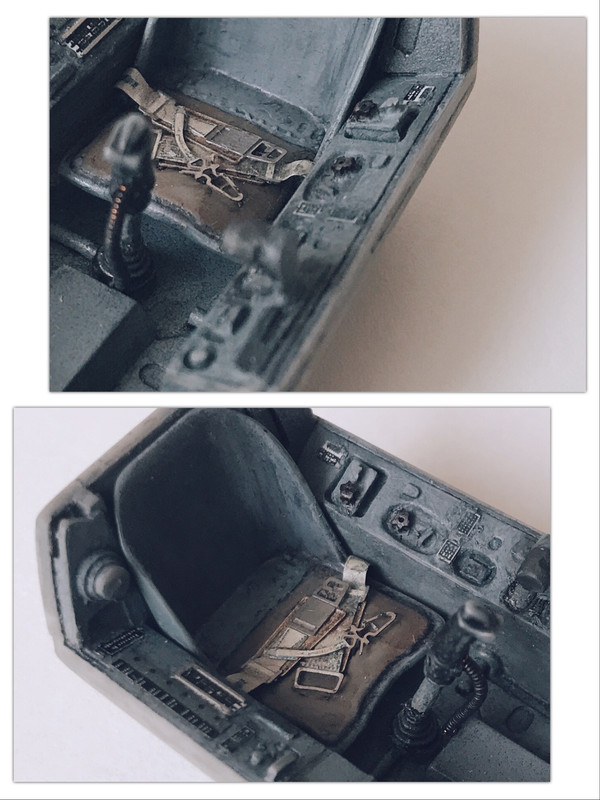
I tried an experiment earlier today where I detailed the brown Bakelite knobs (two, I am able to see) on the side cockpit panel. I used a Tombow Art “Dual Action” Marker. This is an acrylic based marker.
Make more models!
-
Handiabled
- Master Member
- Posts: 591
- Joined: Sat Mar 15, 2014 7:13 am
Re: Pacific Coast Models 1/32 Fw 190A-1. Black 13. Belgium,
Great that you are back to work on this bird, I love the look of the office so far. Hope life has settled down for you now.
Re: Pacific Coast Models 1/32 Fw 190A-1. Black 13. Belgium,
Outstanding Bruce, really outstanding!speedgraflex wrote:I tried an experiment earlier today where I detailed the brown Bakelite knobs (two, I am able to see) on the side cockpit panel. I used a Tombow Art “Dual Action” Marker. This is an acrylic based marker.
- Kari
---
On the bench:
Eduard 1:48 - Fokker D.VII OAW
https://www.facebook.com/GrundAsk-Scale ... 721218708/
On the bench:
Eduard 1:48 - Fokker D.VII OAW
https://www.facebook.com/GrundAsk-Scale ... 721218708/
-
Stikpusher

- Moderator
- Posts: 21386
- Joined: Sat Apr 05, 2014 8:37 pm
- Location: Ceti Alpha 5
Re: Pacific Coast Models 1/32 Fw 190A-1. Black 13. Belgium,

Man, that cockpit is coming along beautifully. Not pristine, but not abused. It just looks like an aircraft that has seen some use.
"Surely I have made my meaning plain? I intend to avenge myself upon you, Admiral. I have deprived your ship of power, and when I swing 'round, I intend to deprive you of your life."
FLSM
FLSM

Re: Pacific Coast Models 1/32 Fw 190A-1. Black 13. Belgium,
and then some!
To make each build less crappy than the last one. Or, put another way, "Better than the last one, not as good as the next one!"..
-
speedgraflex
- Moderator
- Posts: 11534
- Joined: Fri Feb 10, 2017 11:08 pm
- Contact:
Re: Pacific Coast Models 1/32 Fw 190A-1. Black 13. Belgium,
Thanks, gents, sincerely—well, Carlos really articulated what my goal is—I guess it is an obvious one, but it is also an important one for us all—finding our way to verisimilitude, to make something at scale appear close to reality—be it close to factory finish, wartime uses or in the case of Brent’s Horten—more or less what happens at the end of service or end of war. I definitely want to thank each of you specifically because your work continues to be essential study for me. I wish all three of you well with your challenging projects! Your aircraft, armor and warship subjects—and your commitment to doing things right or not doing things at all, those choices get me through the weird moment I am experiencing which unfortunately is upheaval with life and living. I was thinking though that I am just going to use the moment creatively. Not shut down. I think in a weird way the uncertainties will help the build itself.
I don’t know if this is useful for 109/190 electrical systems wiring to you, as you all have done so much research on your projects, but I found this fascinating as the poster is a restorer and a modeler and probably an unofficial electrical engineer. I was wondering why there were no visible color coding to the wiring systems for these aircraft and other Luftwaffe fighters. I mean, how would you repair these systems if they all look alike? This question really bothered me, and now at least I have a reasonable answer:
“It seems that earlier 190s used a braided covering over each individual wire (the exception being multi-conductor cables but even some of these were covered). The predominate color is indeed yellow --- usually. For example, the 190A belonging to a certain Seattle resident is braided and mostly yellow. The Smithsonian 190 is red, black, and yellow. The D-9 at the Dayton museum is all yellow, as far as we could tell, except for one wire on the elevator trim motor which was red. Yellow 10, which I practically lived with for a while, was all yellow except for the main gear motors where some red wires were used. Most 190s had black radio wires except for Y10 which used yellow. It seems that all 190s had braided wire forward of the firewall. All wires and cables in the 190s I'm familiar with were marked with a stamped metal tag folded around each end of the wire. The tag was stamped with a letter/number code which denoted the system and individual wire within that system.” - posted by Jeff C.
I don’t know if this is useful for 109/190 electrical systems wiring to you, as you all have done so much research on your projects, but I found this fascinating as the poster is a restorer and a modeler and probably an unofficial electrical engineer. I was wondering why there were no visible color coding to the wiring systems for these aircraft and other Luftwaffe fighters. I mean, how would you repair these systems if they all look alike? This question really bothered me, and now at least I have a reasonable answer:
“It seems that earlier 190s used a braided covering over each individual wire (the exception being multi-conductor cables but even some of these were covered). The predominate color is indeed yellow --- usually. For example, the 190A belonging to a certain Seattle resident is braided and mostly yellow. The Smithsonian 190 is red, black, and yellow. The D-9 at the Dayton museum is all yellow, as far as we could tell, except for one wire on the elevator trim motor which was red. Yellow 10, which I practically lived with for a while, was all yellow except for the main gear motors where some red wires were used. Most 190s had black radio wires except for Y10 which used yellow. It seems that all 190s had braided wire forward of the firewall. All wires and cables in the 190s I'm familiar with were marked with a stamped metal tag folded around each end of the wire. The tag was stamped with a letter/number code which denoted the system and individual wire within that system.” - posted by Jeff C.
Make more models!
-
Bolleken

- Master Member
- Posts: 696
- Joined: Wed Feb 22, 2017 3:42 am
- Location: Wuppertal - Home of the "Schwebebahn"
Re: Pacific Coast Models 1/32 Fw 190A-1. Black 13. Belgium,
What a fantastic and amazing work. Chapeau!
-
speedgraflex
- Moderator
- Posts: 11534
- Joined: Fri Feb 10, 2017 11:08 pm
- Contact:
Re: Pacific Coast Models 1/32 Fw 190A-1. Black 13. Belgium,
Thank you so much, Marius! Likewise, I believe your work is tops! Chapeaux all around!Bolleken wrote:What a fantastic and amazing work. Chapeau!
Make more models!