Whilst I'm hold with the 262, I thought I've have a crack at this kit - yes it's another strange looking British jet!

Pinched from the Air Vectors website (which is public) - well worth a look.
http://www.airvectors.net/index.html
* In January 1947, the Air Ministry issued the specification F.44/46 for a two-seat, twin-jet-engine, night / all-weather fighter to replace the de Havilland Mosquito. A number of companies responded to the request, but none of their proposals met the requirement. Since there was still a need for a night fighter, Gloster suggested stretching the T.7 by 1.5 meters (five feet) to accommodate airborne intercept (AI) radar in the nose. This machine was intended as an interim solution until the Gloster Javelin, then in development, was ready for service.

NF.11
The proposal was accepted under the specification "F.24/48", but Gloster, having brought up the suggestion, was forced to admit that the company didn't have the resources to produce the machine. However, Armstrong-Whitworth, another member of the Hawker-Siddeley industrial group along with Gloster, had second-sourced the Meteor, and in 1949 Armstrong-Whitworth was given ownership of the project.

Belgian NF.11
The first Meteor "NF.11" (Night Fighter Mark 11) or "G/47" prototype, a modified T.7, began flight tests in October 1949. The first true NF.11 prototype flew on 31 May 1950. The NF.11 retained the Derwent 8 engines of the F.8, but the four cannon were transferred from the nose to the wings, the wings were lengthened back to the original Meteor I span, and the longer nose accommodated AI.10 (US SCR-720) radar, plus a pressurized tandem cockpit. The cockpit featured a T.7 greenhouse canopy and a radar operator / navigator in the back seat.
The first production NF.11, with a proper Meteor F.8 tail, flew on 13 November 1950, and 307 production NF.11s were built. The Danes bought 11; the Belgians obtained 24 ex-RAF aircraft; somewhat surprisingly the French bought 41 used RAF NF.11s; and a single example was sent to Australia, presumably for evaluation.

NF.12
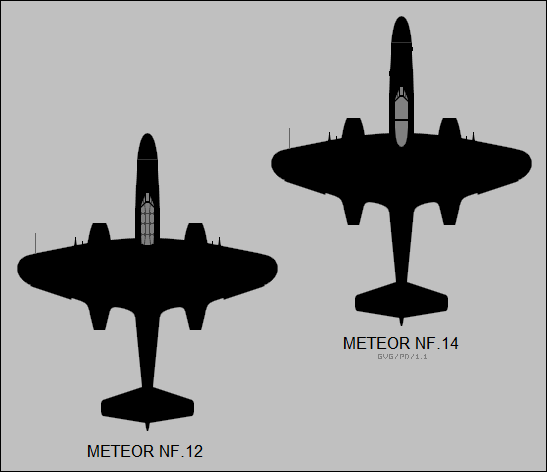
The NF.12 featured Derwent 9 engines with 16.9 kN (1,725 kgp / 3,800 lbf) thrust each, and the nose lengthened by 43 centimeters (17 inches) to accommodate improved American Westinghouse AN/APS-21 radar. The top half of the tailfin was enlarged to compensate for the longer nose, giving the tailfin a slightly crooked appearance. The first NF.12 flew on 21 April 1953, with 100 being built. France obtained two for test purposes, and six each ex-RAF aircraft were provided to Egypt, Syria, and Israel.

NF.14
* The "NF.14" was generally similar to the NF.12, but featured a "blown" clear-vision canopy to provide a much better view than the old framed canopy; improved US AN/APQ-43 radar and an even longer nose; yaw dampers to control "snaking"; and other lesser changes. 100 NF.14s were manufactured and were the final Meteors built, with the very last of the breed delivered on 26 May 1955. The Meteor night fighters remained in front-line RAF service until 1961. The total number of Meteor night-fighters built by Armstrong-Whitworth was 547.
So now you know...
There's nothing quite like a strange looking British cold war jet - the kind of subject Matchbox did well.
Cheers!